







The choice between stablecoins and traditional bank savings accounts fundamentally differs in yield generation mechanisms and risk profiles as of December 2025. Standard USDC stablecoins pay zero interest to holders while Circle earns $634 million quarterly from reserves. High-yield savings accounts offer 4.35-5.00% APY through online banks compared to 0.39% national average. Tokenized treasury funds provide 3.45% average yield combining blockchain rails with U.S. Treasury backing. This comprehensive comparison analyzes actual returns, accessibility requirements, regulatory protection, and 2026 outlook for each option.
The stablecoin market reached $309 billion total capitalization December 2025 with USDC commanding $73.7 billion market share and 25% penetration. Traditional U.S. bank deposits total $17.6 trillion with average savings rate 0.62% APY according to Bankrate’s December 22, 2025 survey. Tokenized treasuries managing $8.84 billion assets bridge these markets offering blockchain settlement with government backing. Understanding yield structures, accessibility barriers, and regulatory frameworks determines optimal allocation for various investor profiles.
Table of Contents
- Market Overview: Stablecoins vs Traditional Banking December 2025
- Comparison Methodology: APY, Access, Risk
- Yield Comparison Table: USDC vs High-Yield vs Tokenized
- USDC Stablecoins: 0% Yield to Holders
- High-Yield Savings Accounts: 4.35-5.00% APY
- Tokenized Treasury Funds: 3.45% Average APY
- Pros and Cons Analysis
- Risk Assessment: FDIC vs Blockchain vs Treasury
- 2026 Yield Predictions and Rate Outlook
- FAQ: Stablecoin vs Bank Account Yield
Market Overview: Stablecoins vs Traditional Banking December 2025
Stablecoin market capitalization expanded from $262 billion to $309 billion during 2025—an 18% increase driven by institutional adoption and cross-border payment applications. USDC circulation grew 108% year-over-year reaching $73.7 billion by Q3 2025 demonstrating accelerating demand for dollar-pegged digital assets. Traditional bank savings accounts hold $17.6 trillion total deposits with national average yield 0.62% APY versus high-yield online banks offering 4.35-5.00% APY creating significant return disparity.
Tokenized treasury funds emerged as hybrid category combining blockchain infrastructure with U.S. Treasury backing. Total value locked reached $8.84 billion December 2025 across 37 distinct products averaging 3.45% net annual percentage yield. This market segment attracts investors seeking yield superior to standard USDC while maintaining on-chain liquidity and settlement advantages versus traditional money market funds.
Federal Reserve maintained federal funds rate at 4.25-4.50% range through December 2025 following three quarter-point cuts between September-December 2024. This elevated rate environment supports high-yield savings accounts offering competitive returns versus historical norms while pressuring future yield expectations if Fed continues normalization toward 2% long-term target.
Comparison Methodology: APY, Access, Risk
Annual Percentage Yield (APY)
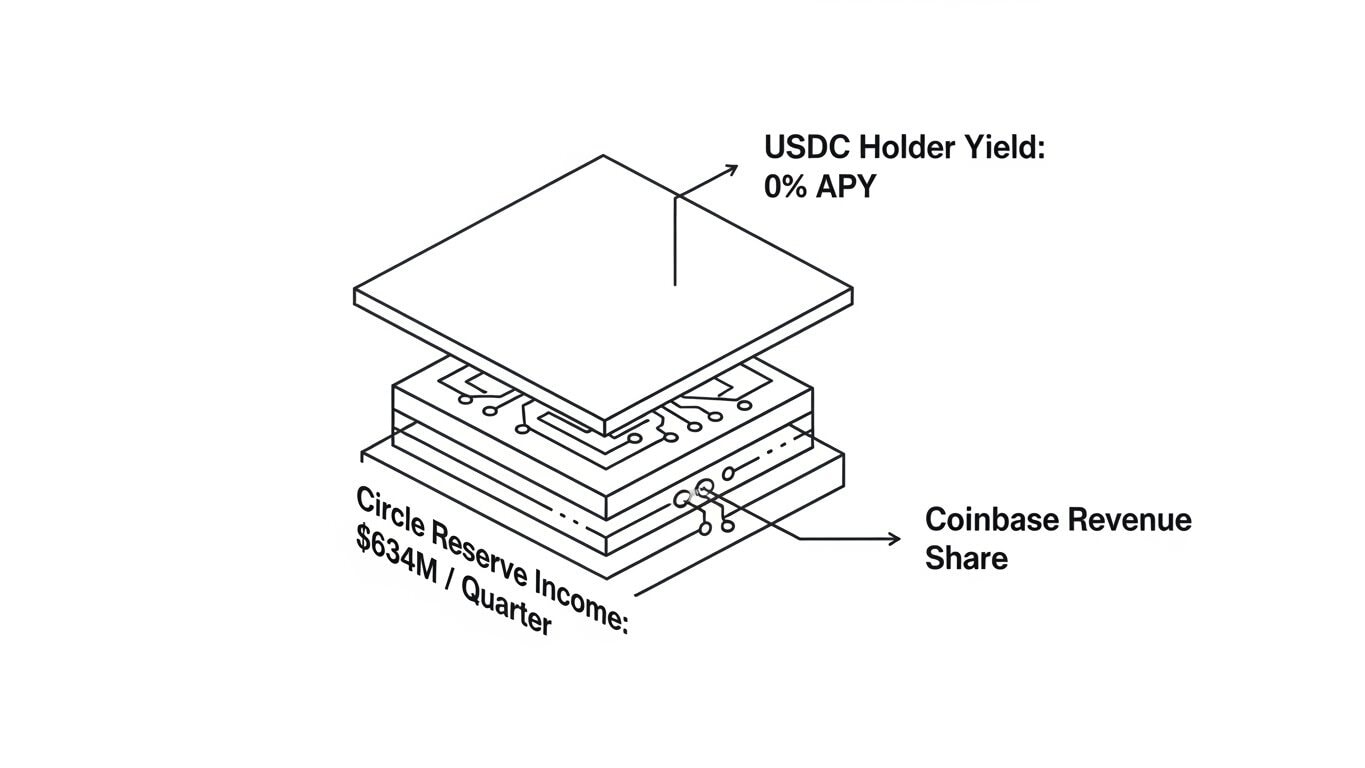
Primary comparison metric measuring total return including compound interest over 12-month period. USDC standard holders receive 0% APY as Circle retains all reserve income—$634 million Q2 2025 revenue from Treasury investments. High-yield savings accounts range 3.30-5.00% APY as of December 22, 2025 per Bankrate survey. Tokenized treasury average 3.45% net APY after management fees deducted from underlying 4.5-5.0% short-term Treasury yields.
Accessibility and Minimum Requirements
USDC requires cryptocurrency wallet and blockchain network access—zero minimum balance but gas fees for Ethereum transactions ($5-30 during peak congestion). High-yield savings accounts accessible through online banking with $0-$500 minimum opening deposits depending on institution. Tokenized treasuries demand $5,000 (Franklin BENJI) to $5 million (BlackRock BUIDL) minimums plus qualified purchaser or accredited investor status for most products.
Regulatory Protection Framework
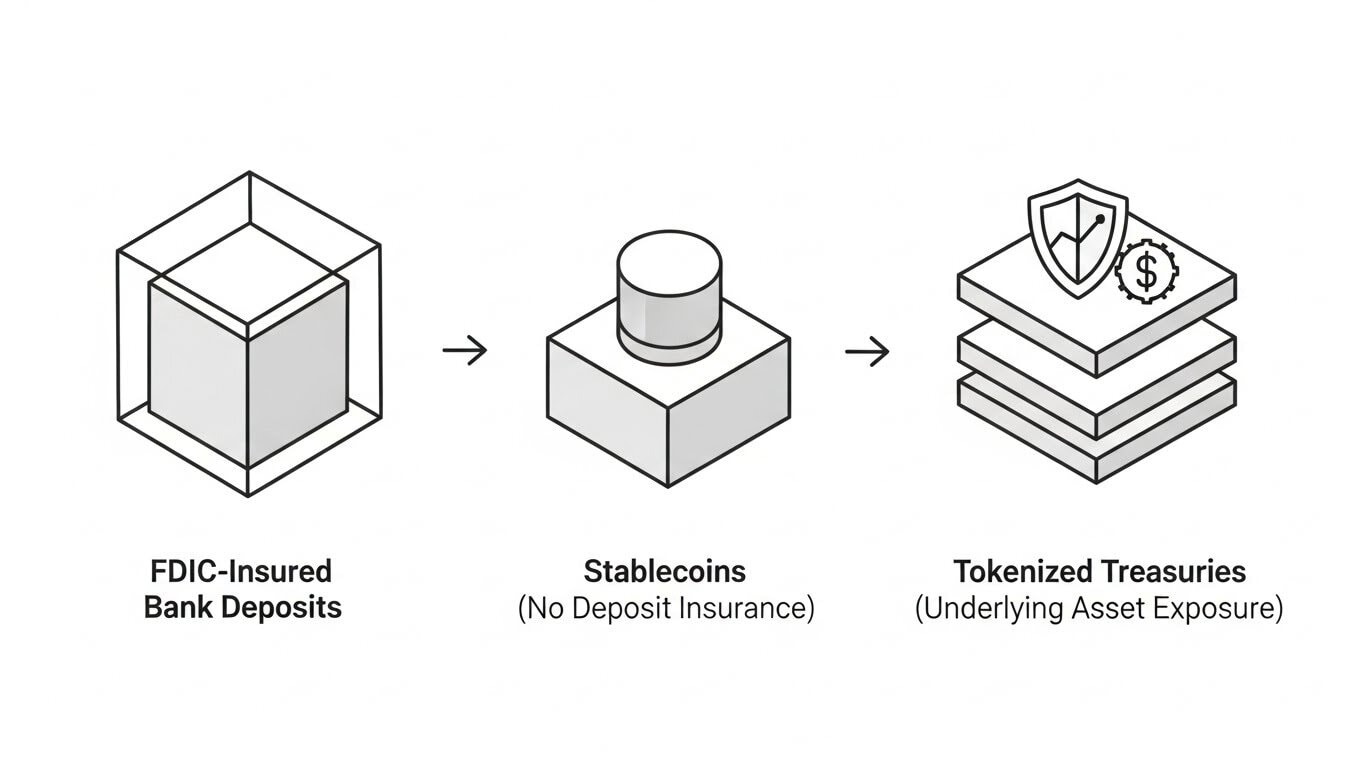
FDIC insurance protects bank deposits up to $250,000 per depositor per institution providing government-backed principal guarantee. USDC reserves held at regulated financial institutions with monthly attestations by Grant Thornton but no direct FDIC protection for token holders. Tokenized treasuries benefit from U.S. Treasury backing of underlying assets with SEC registration and institutional custody through Bank of New York Mellon.
Liquidity and Redemption Terms
USDC enables instant peer-to-peer transfers 24/7 without redemption minimums—Circle institutional redemption requires $100,000 minimum. Bank savings accounts allow unlimited withdrawals without penalties under current Regulation D exemption. Tokenized treasury redemption terms vary by product from same-day (USDC settlement) to T+1 settlement through fund portals with $5,000-$100,000 minimums.
Yield Comparison Table: USDC vs High-Yield vs Tokenized
| Product Type | APY Range | Min. Investment | Protection | Liquidity | Access |
|---|---|---|---|---|---|
| USDC Standard | 0.00% | $0 | Reserve Attestation | Instant 24/7 | Crypto wallet |
| USDC Staking (CeFi) | 4.0-14.0% | $10-$100 | Platform dependent | Variable locks | Exchange account |
| National Avg Savings | 0.39-0.62% | $0-$25 | FDIC $250K | 6/month limit | Bank account |
| High-Yield Savings | 3.30-5.00% | $0-$500 | FDIC $250K | Unlimited | Online bank |
| Tokenized Treasuries | 3.20-4.80% | $5K-$5M | Treasury backing | T+0 to T+1 | Accredited only |
| Money Market Funds | 4.50-5.20% | $1K-$10K | SEC regulation | Same day | Brokerage |
Data as of December 22, 2025
USDC Stablecoins: 0% Yield to Holders
How USDC Works Without Paying Yield
Circle maintains USDC reserves primarily in the Circle Reserve Fund (USDXX)—an SEC-registered 2a-7 government money market fund managed by BlackRock. Circle generated $1.6 billion gross revenue in 2024 on $44 billion average reserves implying 3.6% effective reserve yield. After paying $900+ million distribution costs primarily to Coinbase, Circle retained $768 million net USDC revenue while standard token holders received zero direct yield.
This business model differs fundamentally from traditional banking where depositors earn interest on savings balances. USDC functions as digital payment infrastructure rather than yield-bearing savings account. Holders benefit from instant settlement, 24/7 availability, and borderless transfers but sacrifice interest income generated from underlying Treasury investments.
Third-Party USDC Yield Options
Centralized exchanges and DeFi protocols offer USDC yield through lending and staking mechanisms. Rates vary widely from 2% (Compound) to 14% (Nexo loyalty tier) as of December 2025. Ledn Growth Accounts provide 6.5-8.5% APY depending on balance tier. Aave offers 5.0% variable APY for USDC deposits. These yields derive from lending to borrowers or market-making activities—not direct Treasury income like Circle earns.
Third-party yields introduce additional counterparty risk beyond Circle’s reserve management. CeFi platforms require trusting exchange custody and operational integrity. DeFi protocols expose users to smart contract risks and liquidation mechanics. Higher advertised rates often correlate with increased risk—14% Nexo rate requires locking USDC for 3 months plus holding 10%+ portfolio in NEXO tokens.
USDC Reserve Yield Economics
Circle Q2 2025 reserve income reached $634 million—50% year-over-year increase driven by 86% growth in average USDC circulation partially offset by 103 basis point decline in reserve return rate. Current reserve yield approximately 4.85% down from peak 5.88% as Federal Reserve cuts influence short-term Treasury rates. Coinbase earned 56% of USDC reserve revenue 2024 through revenue-sharing agreement creating major distribution cost for Circle.
The economic model rewards issuers and distribution partners rather than token holders. This structure enables zero-fee USDC transfers and redemptions while funding Circle’s $2.6 billion projected 2025 revenue. Users effectively provide zero-interest loans to Circle in exchange for blockchain payment infrastructure—a trade-off acceptable for transaction purposes but suboptimal for savings allocation.
High-Yield Savings Accounts: 4.35-5.00% APY
Top High-Yield Savings Rates December 2025
Varo Money leads high-yield savings offerings at 5.00% APY as of December 22, 2025 according to NerdWallet analysis. Newtek Bank follows at 4.35% APY with zero minimum balance requirement. Axos Bank provides 4.31% APY with flexible terms. These rates exceed national average 0.39-0.62% APY by 6-13x demonstrating significant yield disparity between online-only banks and traditional brick-and-mortar institutions.
EverBank Performance Savings Account offers 4.20% APY on all balances with no monthly maintenance fee or minimum opening deposit. Jenius Bank provides similar competitive rate focused exclusively on digital banking customers. Western Alliance Bank delivers high-yield option through Raisin platform reducing opening deposit to $1 versus $500 direct requirement. SoFi combined checking and high-yield savings pays up to 3.60% APY on savings balances.
FDIC Insurance and Safety
Federal Deposit Insurance Corporation protects deposits up to $250,000 per depositor per insured institution per ownership category. This government-backed insurance eliminates principal risk for amounts within coverage limits even if bank fails. Coverage applies automatically to accounts at FDIC-member institutions—no application required. High-yield online banks maintain identical FDIC protection as traditional banks despite lacking physical branches.
FDIC insurance coverage can be multiplied through account ownership structures—individual accounts receive $250,000 coverage, joint accounts $500,000 ($250,000 per co-owner), trust accounts based on beneficiary count. Savers with balances exceeding single-account limits can distribute across multiple FDIC-insured institutions maximizing total protection. This strategy enables building substantial FDIC-insured savings portfolio while maintaining competitive yields.
Rate Volatility and Fed Policy Impact
Savings account rates directly correlate with Federal Reserve federal funds rate adjustments. Bankrate historical data shows rates increased dramatically 2022-2023 as Fed raised rates combating inflation—then declined following September-December 2024 rate cuts. Current 4-5% high-yield environment may prove temporary as Fed projects additional cuts pushing rates toward 2% long-term neutral target.
Online banks adjust rates faster than traditional institutions responding to Fed policy changes. High-yield accounts typically feature variable APY—not locked rates like certificates of deposit. Savers benefit during rising rate environments as yields increase without action required. Conversely, declining rate cycles erode returns potentially dropping below inflation rate diminishing real purchasing power despite positive nominal yields.
Tokenized Treasury Funds: 3.45% Average APY
How Tokenized Treasuries Bridge Both Markets
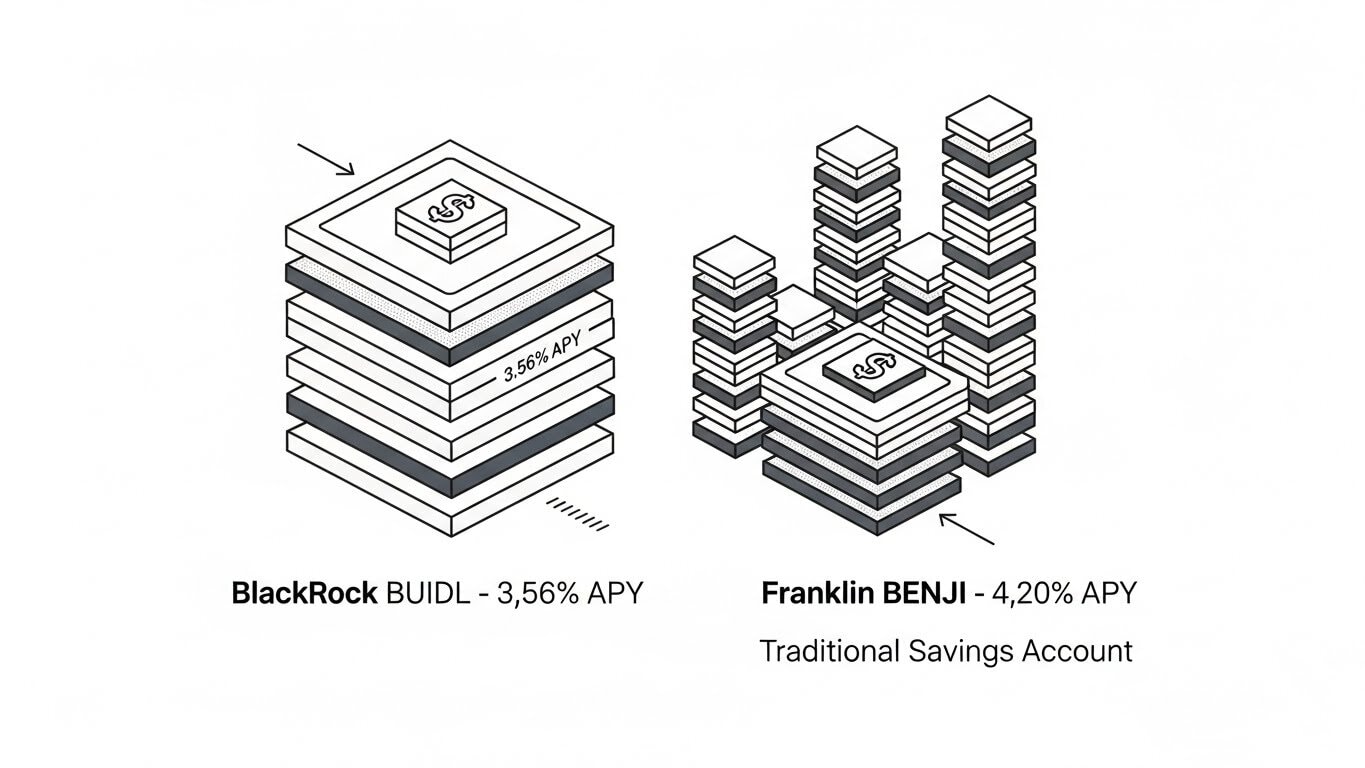
Tokenized treasury products combine blockchain settlement infrastructure with U.S. Treasury backing creating hybrid investment vehicle. BlackRock BUIDL manages $1.75 billion investing in cash, Treasury bills, and repurchase agreements delivering 3.56% net APY. Franklin Templeton BENJI holds $851 million across seven blockchain networks offering 4.20% yield. These products enable 24/7 trading and instant settlement while maintaining government-backed principal protection.
The structure appeals to crypto-native investors seeking yield superior to zero-rate USDC while avoiding complete exit to traditional banking. Tokenized shares transfer peer-to-peer on blockchain networks similar to stablecoins but represent underlying Treasury fund positions. This architecture provides liquidity advantages versus traditional money market funds requiring T+1 settlement through brokerage accounts.
Yield Comparison vs Traditional Treasuries
Direct U.S. Treasury bill purchases yield 4.5-5.0% for short-duration securities matching Federal Reserve interest rate levels. Tokenized treasury funds deduct 0.20-0.50% annual management fees reducing net investor yield to 3.20-4.80% range. This fee structure compensates fund managers (BlackRock, Franklin Templeton, Ondo Finance) for custody, blockchain operations, and regulatory compliance costs absent in direct Treasury ownership.
The management fee trade-off provides benefits including automated dividend distributions through smart contracts, fractional ownership enabling smaller investment sizes, and integration with DeFi protocols for collateral applications. Investors prioritizing maximum yield prefer direct Treasury purchases through TreasuryDirect.gov eliminating intermediary fees. Those valuing blockchain integration and programmatic functionality accept lower net yields for operational advantages.
Accessibility Barriers for Retail Investors
Most tokenized treasury products restrict access to qualified purchasers and accredited investors under SEC regulations. BlackRock BUIDL requires $5 million minimum institutional investment. Circle USYC demands $100,000 minimum plus CFTC Qualified Eligible Participant status. Franklin BENJI offers lowest barrier at $5,000 minimum providing retail accessibility uncommon among tokenized products.
Qualification requirements limit addressable market to high-net-worth individuals and institutional allocators. Retail investors seeking Treasury exposure through blockchain rails face restricted options versus unrestricted access to traditional money market funds and savings accounts. This regulatory framework prioritizes investor protection while constraining democratization of tokenized financial products to mass market.
Pros and Cons Analysis
USDC Stablecoins
Pros:
- Instant 24/7 global transfers without banking intermediaries
- Zero minimum balance or account opening requirements
- Borderless payments eliminating foreign exchange fees
- Integration with DeFi protocols for advanced financial applications
- Transparent blockchain audit trail for all transactions
Cons:
- Zero yield to standard holders (Circle retains all reserve income)
- No FDIC insurance or government deposit guarantee
- Smart contract risks and blockchain network vulnerabilities
- Gas fees for Ethereum transactions during network congestion
- Regulatory uncertainty around stablecoin classification
High-Yield Savings Accounts
Pros:
- Competitive 4.35-5.00% APY significantly exceeding national average
- FDIC insurance protecting $250,000 per depositor per institution
- No minimum balance requirements at many online banks
- Unlimited withdrawal flexibility under current regulations
- Mobile banking apps with modern user experience
Cons:
- Variable APY subject to Federal Reserve rate policy changes
- Online-only banks lack physical branch access for cash deposits
- International wire transfers incur fees and multi-day settlement
- Limited integration with cryptocurrency and blockchain ecosystems
- Inflation erosion during low-rate environments
Tokenized Treasury Funds
Pros:
- U.S. Treasury backing providing government security guarantee
- 24/7 blockchain settlement versus traditional T+1 fund transfers
- Integration with DeFi protocols as collateral and yield sources
- Transparent on-chain reporting of fund holdings and transactions
- Automated dividend distributions through smart contract logic
Cons:
- High minimum investments ($5,000-$5,000,000) restricting access
- Accredited investor requirements excluding retail participants
- Management fees (0.20-0.50%) reducing net yield below direct Treasuries
- Smart contract risks and blockchain infrastructure dependencies
- Limited regulatory precedent creating potential compliance uncertainty
Risk Assessment: FDIC vs Blockchain vs Treasury
Principal Protection Mechanisms
FDIC insurance provides unconditional principal guarantee up to $250,000 coverage limits backed by full faith and credit of U.S. government. Bank failures result in automatic insurance payouts without depositor claims filing—Insurance Fund holds $129 billion reserves covering member institution deposits. This protection mechanism eliminates credit risk for amounts within coverage creating risk-free savings vehicle for qualified balances.
USDC maintains reserves at regulated financial institutions with monthly third-party attestations verifying 1:1 backing. Circle publishes reserve composition showing Treasury bills, repurchase agreements, and cash holdings. This structure provides transparency but not insurance—holders face Circle operational risk, reserve custodian failure risk, and smart contract vulnerabilities. March 2023 Silicon Valley Bank exposure temporarily de-pegged USDC to $0.88 demonstrating concentration risks.
Tokenized treasury funds invest underlying assets in U.S. Treasury securities benefiting from government backing. Bank of New York Mellon provides institutional custody for major products including BlackRock BUIDL and Circle USYC. Fund shareholders face management company operational risk and blockchain infrastructure dependencies but underlying Treasury positions maintain government guarantee. SEC registration provides regulatory oversight and investor protection frameworks.
Interest Rate Risk and Yield Volatility
High-yield savings accounts feature variable APY adjusting continuously with market conditions and Fed policy. Savers face declining yields as interest rates normalize toward long-term 2% neutral target. Current 5% environment may compress to 2-3% within 18-24 months if Fed achieves inflation control. This rate risk affects nominal returns but principal remains protected through FDIC insurance.
Tokenized treasury funds invest in short-duration securities (overnight repos, T-bills under 12 months) minimizing interest rate risk. Price volatility remains minimal as holdings mature quickly and reinvest at current rates. Net yields track Federal Reserve policy with modest lag. Longer-duration tokenized products (if developed) would introduce price sensitivity to rate movements affecting principal values.
USDC standard holders avoid interest rate risk entirely receiving zero yield regardless of rate environment. Third-party USDC lending rates fluctuate with supply-demand dynamics in borrowing markets. DeFi protocol yields prove volatile responding to collateral requirements, liquidation events, and protocol token incentives creating unpredictable return profiles.
Counterparty and Operational Risks
Bank deposits concentrate risk in single FDIC-insured institution up to coverage limits. Diversification across multiple banks multiplies protection but increases operational complexity. Online bank operational failures could temporarily restrict access to funds during system outages or cyber incidents. FDIC insurance protects principal but not liquidity during resolution processes.
USDC introduces multiple counterparty dependencies: Circle operational integrity, reserve custodian financial health, blockchain network security, and smart contract code quality. Circle Internet Financial LLC operates as centralized issuer with authority to freeze addresses and update smart contracts. Decentralization advocates criticize this control structure as incompatible with blockchain principles despite practical regulatory necessities.
Tokenized treasury products layer additional counterparties including fund managers (BlackRock, Franklin Templeton), blockchain infrastructure providers, and transfer agents. Smart contract vulnerabilities could enable theft or freezing of tokenized shares. Regulatory changes affecting digital securities classification might force structural modifications impacting investor holdings or tax treatment.
2026 Yield Predictions and Rate Outlook
Federal Reserve Policy Path
Federal Reserve projections indicate additional 50-75 basis points rate cuts through 2026 bringing federal funds rate to 3.50-4.00% range by December 2026. JPMorgan analysts forecast measured pace avoiding aggressive easing given persistent inflation above 2% target. Labor market strength and wage growth support gradual normalization rather than emergency cuts signaling economic distress.
This baseline scenario implies high-yield savings rates declining from current 4.35-5.00% range to 3.00-4.00% by end-2026. National average savings rates may compress to 0.25-0.40% maintaining historical spread versus high-yield offerings. Tokenized treasury yields would track similar trajectory as underlying short-term Treasury rates adjust downward with Fed policy.
Stablecoin Yield Evolution
Circle reserve income faces pressure from declining interest rates reducing profitability on USDC reserves. Company must adapt business model if rates return to near-zero levels eliminating primary revenue source. Potential strategies include introducing yield-bearing USDC variant sharing reserve income with holders or expanding transaction fees currently waived for competitive positioning.
Yield-bearing stablecoin competition intensifies as Hashnote USYC (acquired by Circle) and emerging products offer direct yield distribution to token holders. This model shift addresses $12 billion annual wealth transfer from zero-rate stablecoin holders to issuers. Market pressure may force USDC adopting yield-sharing mechanisms by 2026 to maintain competitive position versus interest-bearing alternatives.
Tokenized Treasury Market Expansion
Tokenized treasury market projected reaching $15-20 billion assets under management by June 2026 based on current 124% annual growth rate. Traditional asset managers including Fidelity filed SEC registration December 2025 preparing product launches. Bank-issued tokenized deposits from JPMorgan, SoFi, and consortium approaches may compete directly with existing offerings.
Regulatory clarity from GENIUS Act passage July 2025 and ongoing SEC guidance accelerates institutional adoption. Retail-accessible products with lower minimums could democratize market beyond current accredited investor restrictions. DeFi integration deepens as tokenized treasuries serve as collateral for lending protocols and backing for next-generation yield-bearing stablecoins.
FAQ: Stablecoin vs Bank Account Yield 2026
Do USDC holders earn interest on their stablecoins?
No, standard USDC holders receive 0% yield despite Circle earning $634 million quarterly from reserve investments. Circle retains all interest income generated from Treasury bills and repurchase agreements backing USDC. Third-party platforms like Aave (5% APY) and Ledn (8.5% APY) offer USDC yield through lending mechanisms introducing additional counterparty risks beyond Circle’s reserve management.
What are the best high-yield savings account rates in December 2025?
Top high-yield savings accounts offer 4.35-5.00% APY as of December 22, 2025. Varo Money leads at 5.00% APY, Newtek Bank provides 4.35% APY, and Axos Bank delivers 4.31% APY. These rates exceed national average 0.39% APY by 11-13x while maintaining FDIC insurance protection up to $250,000 per depositor per institution.
Are tokenized treasury funds safer than bank savings accounts?
Tokenized treasury funds and FDIC-insured savings accounts offer different safety mechanisms rather than hierarchical safety ranking. Bank deposits provide unconditional principal guarantee through FDIC insurance for amounts up to $250,000. Tokenized treasuries benefit from U.S. Treasury backing of underlying assets but introduce blockchain infrastructure risks and smart contract vulnerabilities absent in traditional banking.
How do tokenized treasury yields compare to direct Treasury purchases?
Direct U.S. Treasury bills yield 4.5-5.0% for short-duration securities versus 3.20-4.80% net APY for tokenized treasury funds after management fees. The 0.20-0.50% fee differential compensates for blockchain operations, automated distributions, and fractional ownership enabling smaller investment sizes. Investors prioritizing maximum yield prefer direct purchases while those valuing blockchain integration accept lower net returns.
Will high-yield savings rates decrease in 2026?
Yes, high-yield savings rates likely decline to 3.00-4.00% range by December 2026 following projected Federal Reserve rate cuts of 50-75 basis points. Current 5% maximum rates reflect elevated federal funds rate at 4.25-4.50% as of December 2025. Gradual Fed normalization toward 2% long-term neutral target will compress savings yields across all institutions.
Can I combine stablecoins and bank accounts for higher returns?
Yes, diversified allocation across stablecoins, bank savings, and tokenized treasuries optimizes risk-adjusted returns. Strategy example: Emergency fund in FDIC-insured high-yield savings (4-5% APY) for instant access and principal protection, medium-term savings in tokenized treasuries (3.45% APY) for blockchain integration benefits, transaction balances in USDC for instant global transfers despite zero yield. This approach balances yield, liquidity, and risk tolerance.
Related Resources
- SoFi launched SoFiUSD stablecoin December 18, 2025 as first bank-issued token on public blockchain
- JPMorgan deposit token JPMD launched June 2025 on Coinbase Base network
Sources
- Best High-Yield Savings Accounts Of December 2025 – Bankrate December 22, 2025
- Best High-Yield Savings Accounts of December 2025 – NerdWallet December 22, 2025
- Best High-Yield Savings Account Rates December 22, 2025 – Fortune December 22, 2025
- USDC: Digital Dollar Backed by Reserves – Circle Official Website
- Behind Circle’s USDC Treasury: How Yield Gets Generated – Stablecoin Insider June 17, 2025
- Circle Statistics 2025: $740M Q3 Revenue – CoinLaw December 21, 2025
- Best USDC Interest Rates for Passive Income 2025 – Ledn Blog
- JPMorgan Reiterates Stablecoin Market Won’t Hit Trillion-Dollar Levels – The Block December 19, 2025