








Table of Contents
- AI Travel Planner Evolution in Luxury Aviation
- Booking Automation: Customer Interface vs Operator Coordination
- Customer Intelligence: Preferences and Behavioral Learning
- Payment Processing: Crypto Integration and Token Rewards
- The Human-AI Division: What Technology Handles vs Requires Expertise
- Sphera AI Platform: Architecture and Customer Journey
- Evaluating AI Travel Planners: Critical Assessment Framework
- Implementation Strategy for AI-Augmented Travel Booking
Introduction
The AI travel planner has transformed from experimental chatbot to essential booking interface for luxury aviation in 2026. Modern platforms process customer preferences, interpret travel intent through natural language conversation, and present aircraft options with transparent pricing. What once required multiple phone calls and email exchanges with travel advisors now happens through intelligent interfaces that remember your preferences and streamline decision-making.
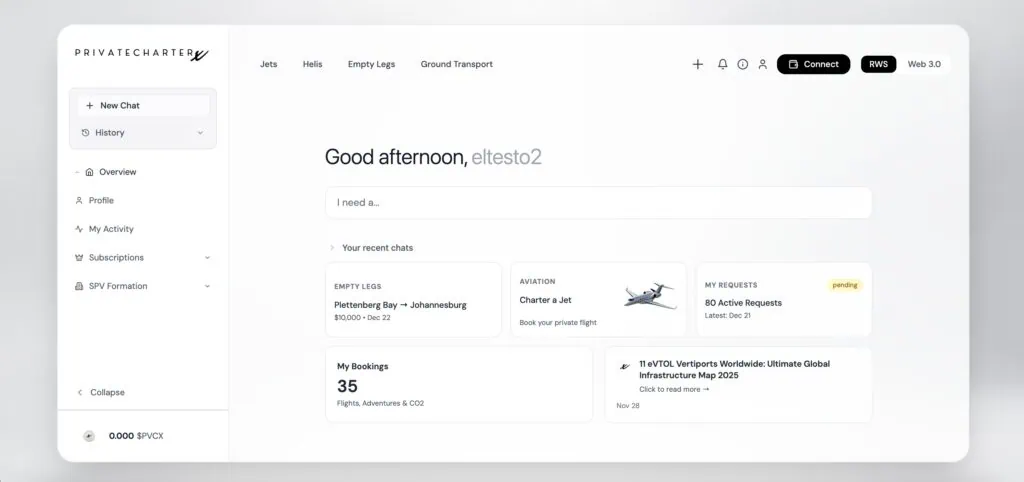
Private aviation represents the most sophisticated application of AI travel planner technology, not because AI books flights directly, but because it manages the complex customer-facing experience while human specialists handle operator coordination. Platforms like PrivateCharterX’s Sphera AI separate customer intelligence from operational complexity. The AI interprets your requirements and processes payments including cryptocurrency, while charter specialists coordinate with aviation partners to execute your flight.
The AI travel planner market reached $1.2 billion in 2025, projected to grow at 28% CAGR through 2030 as luxury travelers adopt intelligent booking interfaces. The technology has crossed the threshold from novelty to necessity for anyone seeking transparent pricing, preference memory, and 24/7 booking availability. Understanding what AI actually handles versus what requires human expertise determines whether you maximize this technology’s benefits or fall victim to unrealistic expectations.
AI Travel Planner Evolution in Luxury Aviation
The AI travel planner evolution in luxury aviation reflects a fundamental shift from operator-facing tools to customer-facing intelligence layers. Early systems in 2020-2022 focused on internal operator efficiency, automating pricing calculations and availability checks for charter brokers. Modern platforms in 2026 put AI between the customer and the booking process, handling preference interpretation, option presentation, and payment processing.
This architectural change solves a critical friction point in private aviation booking. Customers previously contacted charter brokers, described their requirements, waited for availability checks across multiple operators, received pricing quotes, negotiated terms, and finally completed payment through separate channels. Each touchpoint introduced delay and potential miscommunication. The AI travel planner consolidates these steps into a single conversational interface.
Natural language processing enables customers to express complex travel intent without rigid form structures. “I need to fly from Zurich to Dubai next Tuesday with my family and two dogs, returning Friday” becomes structured data the system can work with. The AI extracts key parameters including origin, destination, dates, passenger count, pet requirements, and round-trip intent. It then presents aircraft options that meet these criteria with pricing transparency.
However, the AI travel planner doesn’t coordinate directly with thousands of aircraft operators. That would require real-time API integrations with fragmented aviation companies, constantly updated availability databases, and regulatory compliance verification across jurisdictions. Instead, the AI presents options based on typical aircraft availability and pricing patterns, while human charter specialists at platforms like PrivateCharterX handle actual operator coordination after booking confirmation.
Booking Automation: Customer Interface vs Operator Coordination
Understanding the division between booking automation and operator coordination clarifies what AI travel planners actually accomplish in 2026. The customer-facing automation handles preference capture, option presentation, pricing display, and payment processing. The operator coordination requires human relationships, regulatory expertise, aircraft verification, and crisis management capabilities that current AI cannot replicate.
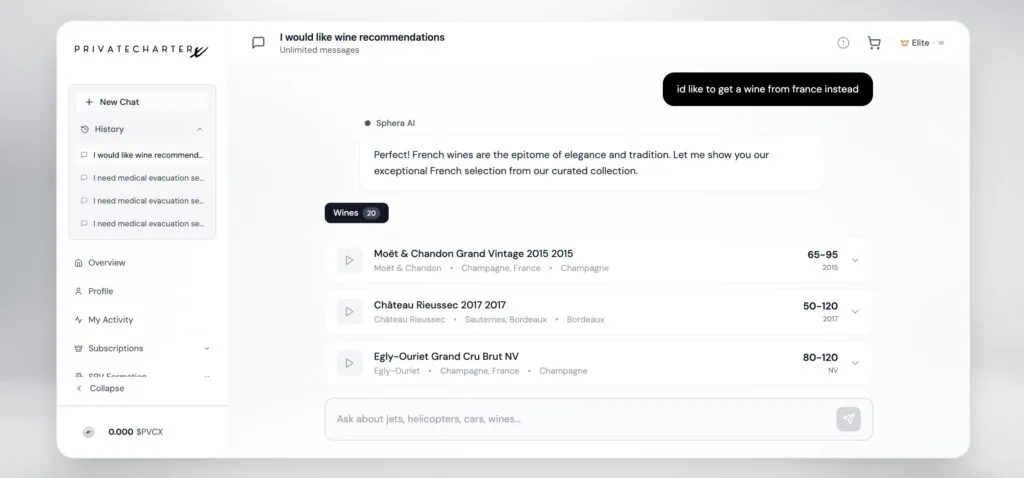
The AI travel planner guides customers through structured decision-making. It asks qualifying questions to narrow aircraft options based on passenger count, baggage requirements, route distance, and budget parameters. As you answer questions or modify preferences, the system dynamically updates available options. This interactive guidance replaces static web forms that require customers to understand aviation terminology like “light jet” versus “super-midsize” before making selections.
Payment processing integration represents significant AI travel planner value in 2026. Traditional charter booking required wire transfers, credit card authorizations over phone, or manual invoice processing. Modern platforms like Sphera AI handle payment securely within the booking interface, accepting both traditional payment methods and cryptocurrency. This reduces booking friction from hours or days to minutes for payment completion.
After payment confirmation, the human coordination phase begins. Charter specialists contact the customer to verify flight details, coordinate with partner aviation operators to secure the specific aircraft, handle regulatory requirements including customs documentation and flight plan filing, arrange ground transportation if requested, and serve as the customer’s single point of contact for any adjustments. This human touchpoint ensures quality control that automated systems cannot guarantee.
The architectural separation makes economic sense. AI scales infinitely for customer interactions, handling thousands of simultaneous booking conversations at near-zero marginal cost. Human specialists scale linearly but provide irreplaceable value in operator relationships, regulatory navigation, and service quality assurance. Combining both creates sustainable business models where technology efficiency funds human expertise.
Customer Intelligence: Preferences and Behavioral Learning
Customer intelligence separates sophisticated AI travel planners from basic booking forms. The system builds persistent profiles over time, learning from past bookings and inquiries, stated preferences including aircraft type and timing, and behavioral patterns like booking lead time and route repetition. This accumulated knowledge enables the platform to transition from reactive booking to proactive personalization.
Preference memory captures explicit customer selections. When you book a midsize jet for a Zurich-London route, the AI travel planner records this choice. After several bookings, patterns emerge. You consistently select aircraft with specific cabin configurations, prefer morning departures, choose particular FBO locations when available, and request similar catering options. The system uses this historical data to prioritize matching options in future searches.
Behavioral analysis identifies implicit preferences you might not consciously recognize. If you always book flights with 2-3 week lead time but occasionally make last-minute requests when attending urgent business meetings, the AI learns to distinguish routine travel from time-sensitive situations. When you search for immediate availability, it prioritizes speed over price. When you plan weeks ahead, it surfaces cost-optimized options including potential empty leg opportunities.
Context-aware recommendations improve through usage. After a dozen bookings through the same AI travel planner, the system accurately predicts which aircraft class you’ll select for different route types, which departure time windows align with your schedule patterns, and which ancillary services you value versus skip. This personalization reduces decision fatigue by filtering potentially overwhelming options to the 3-5 most aligned with demonstrated preferences.
The customer intelligence value compounds over customer lifetime. Traditional charter brokers maintain relationship memory through individual advisor notes and personal recall. AI travel planners democratize this institutional knowledge, making every customer interaction informed by their complete booking history regardless of which human specialist ultimately coordinates their flight. This consistency improves customer experience while reducing reliance on manual CRM processes.
Experience intelligent private aviation booking. Sphera AI by PrivateCharterX combines customer preference learning with human charter specialists for transparent pricing, cryptocurrency payment options, and token rewards. Book private jets and helicopter transfers with 24/7 intelligent assistance backed by aviation experts.
Payment Processing: Crypto Integration and Token Rewards
Payment processing integration distinguishes modern AI travel planners from previous generation booking platforms. Traditional private aviation payment required wire transfers with multi-day settlement, credit card authorizations over phone with security concerns, or manual invoice processing introducing administrative overhead. The AI travel planner consolidates payment into the booking flow with both conventional and cryptocurrency options.
Cryptocurrency acceptance addresses a specific customer segment in luxury aviation. High-net-worth individuals with significant cryptocurrency holdings face friction converting crypto to fiat currency for travel purchases. Early platforms required customers to use third-party exchanges, creating tax events and transaction fees. Direct cryptocurrency payment processing eliminates this friction, accepting Bitcoin, Ethereum, stablecoins, and other major digital assets at point of booking.
The technical infrastructure for crypto payments requires specialized integration. The AI travel planner connects to payment processors that handle cryptocurrency-to-fiat conversion or maintain crypto balances depending on operator preference. Real-time exchange rate calculations ensure pricing accuracy regardless of crypto market volatility. Transaction confirmation happens within minutes rather than the multi-day settlement cycles of traditional wire transfers.
Token reward systems create loyalty mechanisms aligned with Web3 principles. After completing a booking and payment through the AI travel planner, the system automatically distributes platform tokens to the customer’s connected wallet. These tokens accumulate across multiple bookings, creating incentive structures for repeat usage. Future implementations may enable token holders to access exclusive pricing, priority availability during peak seasons, or redemption for upgrades.
The payment and rewards integration serves dual purposes. For customers, it provides booking convenience and ongoing value accumulation. For platforms, it creates switching costs that improve customer lifetime value and reduces customer acquisition cost through organic retention. As the AI travel planner ecosystem expands to include yacht charters and other luxury mobility services, token rewards bridge across service categories, building comprehensive luxury travel ecosystems.
The Human-AI Division: What Technology Handles vs Requires Expertise
The human-AI division in luxury aviation booking determines platform effectiveness and customer satisfaction. Platforms that blur this line by overpromising AI capabilities create service failures. Platforms that clarify the division enable customers to leverage technology advantages while maintaining access to human expertise when situations demand it.
The AI travel planner handles customer-facing interaction design. It interprets natural language booking requests, asks clarifying questions to structure requirements, presents aircraft options with transparent pricing, captures customer preferences for future personalization, processes payments including cryptocurrency, and distributes token rewards automatically. These tasks benefit from AI’s scalability, consistency, and 24/7 availability.
Human charter specialists handle operator coordination and relationship management. They verify aircraft availability with partner operators after booking confirmation, coordinate regulatory requirements including flight plan filing and customs documentation, manage ground transportation arrangements when requested, serve as customer point of contact for flight modifications or cancellations, and handle crisis situations requiring judgment and negotiation. These tasks require aviation expertise, industry relationships, and decision-making under uncertainty.
The handoff occurs at booking confirmation. When you complete payment through the AI travel planner, the system generates a booking record with all your preferences and requirements. A charter specialist receives automatic notification and contacts you within specified timeframes to coordinate flight details. You receive both the efficiency of automated booking and the assurance of human oversight for flight execution.
This division addresses a critical trust issue in luxury aviation. Customers booking high-value private jet charters need confidence that their flight will actually happen as planned. Automated systems claiming end-to-end booking without human verification create anxiety about edge cases. The hybrid model provides technology convenience for routine aspects while maintaining human accountability for service delivery.
Crisis management scenarios particularly benefit from human involvement. When weather disrupts your planned departure, when aircraft mechanical issues require substitution, when destination conditions change requiring route modifications, or when you need last-minute itinerary changes, human specialists leverage operator relationships and aviation expertise to solve problems. An AI travel planner can present options, but cannot negotiate with air traffic control or convince operators to prioritize your rebooking.
Sphera AI Platform: Architecture and Customer Journey
Sphera AI represents PrivateCharterX’s implementation of the AI travel planner architecture, serving as the intelligence layer that combines booking automation, customer intelligence, and payment processing. The platform augments rather than replaces human decision-making, enabling scale, consistency, and efficiency while maintaining quality control through charter specialist oversight.
The customer journey begins with trip intent interpretation. Sphera AI processes natural language descriptions of travel requirements, extracting structured data about origin, destination, timing, passenger count, baggage, pets, and special requirements. Rather than forcing customers to navigate complex aviation terminology, the conversational interface asks intuitive questions that reveal underlying needs. “Flying with golf clubs and my family” translates to minimum baggage capacity and passenger count requirements.
Option presentation emphasizes transparency and customer control. The AI travel planner displays available aircraft categories with clear pricing breakdowns, showing base charter cost, fuel surcharges, potential landing fees, and total estimated cost. Customers select aircraft based on capacity, amenities, budget, and availability without requiring aviation expertise. Detailed aircraft descriptions include cabin photos, seating configurations, range capabilities, and typical flight times for the requested route.
Preference configuration happens within the platform interface. Customers specify preferences for aircraft cabin layout, catering requirements and dietary restrictions, departure time windows and flexibility, ground transportation needs, and communication preferences for flight updates. The system stores these preferences to inform future bookings while allowing override for specific trips where requirements differ from typical patterns.
Payment processing handles both traditional and cryptocurrency transactions. After aircraft selection, the AI travel planner presents final pricing with all fees itemized. Customers choose payment method, with crypto payments calculating real-time exchange rates for accurate charge amounts. Payment confirmation triggers automatic token reward distribution to the customer’s connected wallet, with reward amounts based on booking value and customer tier status.
Post-booking coordination begins immediately after payment. A PrivateCharterX charter specialist receives the booking details, reviews customer preferences and requirements, contacts the customer to confirm flight details and answer questions, coordinates with partner aviation operators to secure the specific aircraft, and manages all regulatory compliance including flight planning and customs. The customer receives a single point of contact who handles coordination through flight completion.
Future expansion includes yacht charter integration. The same AI travel planner interface will support luxury maritime bookings, leveraging the customer intelligence and preference memory built through aviation bookings. Token rewards accumulate across both aviation and maritime services, creating comprehensive luxury mobility ecosystems where customer loyalty compounds across service categories.
Evaluating AI Travel Planners: Critical Assessment Framework
Evaluating AI travel planners requires distinguishing marketing claims from actual capabilities. Many platforms overpromise automation that doesn’t exist, creating service failures and customer disappointment. A systematic assessment framework identifies platforms that deliver genuine value versus those making unrealistic claims about AI capabilities.
Architectural transparency reveals what the AI actually handles versus what requires human intervention. Platforms should clearly specify whether the AI directly books with operators or serves as customer interface while humans coordinate execution. Claims about “AI booking thousands of flights” often mean the interface processes customer requests while humans handle actual operator coordination. Transparent platforms specify this division rather than implying full automation.
Payment integration capabilities determine booking friction levels. Traditional charter platforms require separate payment coordination, introducing delays and security concerns. Modern AI travel planners with integrated payment processing enable booking completion within the interface, accepting credit cards, bank transfers, and cryptocurrency. Token reward automation indicates sophisticated payment infrastructure rather than manual loyalty program management.
Customer intelligence depth separates basic forms from learning systems. Simple platforms capture preferences but don’t apply them to future bookings. Sophisticated AI travel planners build persistent profiles that inform option prioritization, detect behavioral patterns that reveal implicit preferences, and provide context-aware recommendations improving with usage. Request examples of how the platform personalizes based on booking history.
Human backup availability determines what happens when situations exceed AI capabilities. Platforms should specify guaranteed response times for charter specialist contact, 24/7 availability for urgent situations and flight modifications, and escalation processes when AI cannot address customer needs. The best hybrid systems provide seamless handoff to specialists who inherit full conversation context rather than forcing customers to restart explanations.
Privacy and data security policies matter significantly for high-net-worth travelers. Verify how customer data is stored and used, whether the platform sells anonymized data to third parties, payment credential encryption standards, and geographic data storage locations for GDPR compliance. Platforms targeting luxury aviation should maintain strict confidentiality given that travel patterns reveal valuable competitive intelligence.
Realistic capability representation builds trust. Platforms that acknowledge AI limitations while highlighting genuine automation benefits demonstrate operational maturity. Be skeptical of claims about “AI booking flights across 10,000 operators” without specifying human coordination roles. Focus on platforms that separate customer-facing intelligence from operator coordination, making both visible rather than obscuring the human involvement required for service delivery.
Implementation Strategy for AI-Augmented Travel Booking
Implementing AI travel planners effectively requires understanding what technology actually provides versus what requires human expertise. Successful adoption balances automation benefits with realistic expectations about AI capabilities and necessary human involvement. Strategic implementation maximizes technology value while maintaining service quality through appropriate human oversight.
Start with clear use case definition. AI travel planners excel at routine booking requests where requirements fit standard parameters. Zurich-London next week for four passengers with typical timing flexibility represents ideal AI-guided booking. Complex itineraries with unusual requirements, tight timing constraints, or destinations requiring special regulatory handling benefit from early human specialist involvement alongside AI interface usage.
Establish comprehensive preference profiles before expecting personalized recommendations. Configure aircraft type preferences based on past bookings, specify typical passenger counts and baggage requirements, set departure time windows and flexibility parameters, define catering preferences and dietary restrictions, and indicate ground transportation preferences. The more detailed your initial profile, the more accurate AI recommendations become from first usage.
Test platform capabilities on low-stakes bookings initially. Book a familiar route you’ve flown multiple times to evaluate whether AI-presented options align with your known preferences. Verify payment processing smoothness including cryptocurrency if that’s your preferred method. Assess charter specialist responsiveness and competence when they contact you post-booking. This controlled testing reveals platform strengths and limitations before relying on it for critical travel.
Maintain realistic expectations about automation scope. The AI handles booking interface and customer preferences, not direct operator coordination or flight execution. Charter specialists managing post-booking coordination require reasonable lead time for complex itineraries. Last-minute bookings benefit from direct specialist contact rather than exclusive reliance on automated interface. Understanding this division prevents frustration when situations require human intervention.
Leverage customer intelligence features actively. When the AI travel planner makes recommendations you reject, specify why (aircraft too small, routing inefficient, pricing above budget). This feedback improves future suggestions. When AI suggests an option you love that you wouldn’t have discovered manually, confirm this as positive signal. Machine learning systems improve through reinforcement from customer reactions.
Evaluate cryptocurrency payment and token rewards if that aligns with your holdings. Platforms like PrivateCharterX offering crypto payment eliminate the friction of converting digital assets to fiat currency for travel purchases. Token reward accumulation creates ongoing value, particularly if you book frequently or the platform expands to adjacent services like yacht charters where the same rewards apply.
Build relationships with charter specialists despite automated interface. While the AI travel planner handles routine booking flow, developing rapport with human specialists who coordinate your flights improves service quality when complications arise. Specialists familiar with your preferences and communication style provide better crisis management, proactive suggestions, and service recovery when needed.
Conclusion
The AI travel planner represents transformative technology for luxury aviation when implemented with clear understanding of what AI handles versus what requires human expertise. Modern platforms excel at customer-facing interaction design, preference learning, payment processing including cryptocurrency, and token reward distribution. These capabilities deliver genuine value through booking convenience, pricing transparency, and ongoing loyalty incentives.
However, the operational complexity of private aviation still requires human coordination. Charter specialists manage operator relationships, verify aircraft availability, handle regulatory compliance, and provide crisis management when situations deviate from standard parameters. The most effective platforms like PrivateCharterX’s Sphera AI separate customer intelligence from operator coordination, making both visible rather than overpromising automation capabilities.
As AI travel planners evolve, the customer intelligence layer will become increasingly sophisticated. Predictive recommendations based on calendar integration and communication pattern analysis will anticipate travel needs before customers consciously recognize them. Behavioral learning will enable genuinely personalized option prioritization that improves continuously through usage. Payment and reward systems will bridge across expanded service categories including yacht charters, creating comprehensive luxury mobility ecosystems.
The future of luxury aviation booking isn’t choosing between AI and human specialists. It’s leveraging AI for customer interaction, preference memory, and payment processing while maintaining human coordination for operator relationships and service delivery. Platforms that clarify this division build trust through realistic capability representation. Customers benefit from technology efficiency funding human expertise rather than eliminating it, creating sustainable service models that scale through intelligent automation while preserving quality through professional oversight.
Related Resources
- Private Jet Membership Programs: NetJets vs VistaJet Comparison
- Helicopter Charter Price Switzerland: Complete 2025 Cost Guide
- eVTOL Market 2026: Joby Dubai Launch Investment Boom
- eVTOL vs Helicopter Cost Comparison: 2025 Analysis
Frequently Asked Questions
What is an AI travel planner and how does it work for private aviation?
An AI travel planner for private aviation serves as an intelligent booking interface that interprets customer travel requirements through natural language, presents aircraft options with transparent pricing, processes payments including cryptocurrency, and manages customer preferences for personalization. The AI handles customer-facing interaction while human charter specialists coordinate with aviation operators to execute flights after booking confirmation.
Does the AI actually book private jets or do humans coordinate flights?
The AI manages the booking interface, customer preferences, and payment processing. Human charter specialists coordinate actual flights with partner aviation operators after customers complete booking through the AI platform. This division ensures technology efficiency for customer interaction while maintaining human expertise for operator relationships, regulatory compliance, and service quality assurance.
Can I pay for private jet bookings with cryptocurrency?
Modern AI travel planners like PrivateCharterX’s Sphera AI accept cryptocurrency payments including Bitcoin, Ethereum, and stablecoins alongside traditional payment methods. The platform handles real-time exchange rate calculations and crypto-to-fiat conversion, eliminating the friction of using third-party exchanges. Token rewards distribute automatically to your connected wallet after booking completion.
How does the AI learn my preferences for future bookings?
The AI travel planner builds persistent customer profiles from past bookings and inquiries, stated preferences you configure in the platform, and behavioral patterns it detects through usage. After multiple bookings, the system recognizes your aircraft type preferences, timing patterns, budget parameters, and service priorities. This learning enables personalized recommendations that improve continuously.
What happens after I complete a booking through the AI platform?
After payment confirmation, a charter specialist from the platform contacts you to verify flight details and coordinate with partner aviation operators. The specialist secures the specific aircraft, handles regulatory requirements including flight planning and customs documentation, arranges requested ground transportation, and serves as your point of contact through flight completion. Token rewards distribute automatically to your wallet.
What are the limitations of AI in luxury aviation booking?
AI cannot replace human coordination for operator relationships, regulatory compliance verification, crisis management during flight disruptions, or subjective judgment in complex itineraries. The technology excels at customer interface and preference management but requires human specialists for actual flight execution. Platforms that acknowledge this division provide more reliable service than those claiming full automation.
Sources
- PhocusWire: AI Developments in Travel B2C and B2B 2025
- The Points Guy: How AI Is Transforming the Future of Travel
- Travala: How Many Travelers Use AI for Booking Key Insights 2025
- NBAA: National Business Aviation Association
- CNBC: 5 Major Trends Set to Shape Travel in 2026
- Luxury Travel Magazine: Luxury Travel Trends 2025 Tailored Tech
- WATG: Luxury Travel Trends 2025 The Next Wave of Opportunity
- Gourmet Marketing: 19 Travel Trends Shaping 2026
- Hospitality Net: 7 Travel and Hospitality Trends That Defined 2025
- Henley & Partners: Global Travel Trends 2025 Growth Challenges Future Luxury





![Apple Vision Pro headset displayed on modern desk with soft lighting fashion magazine style photography"]](https://privatecharterx.blog/wp-content/uploads/2025/08/romeo-a-TGQQbDoG2C4-unsplash-scaled-527x703.jpg "Apple Vision Pro Complete Review: Ultimate 2025 Guide - Is It Worth $3,500? 33")