







Table of Contents
- SEC Approves DTCC Tokenization: December 11, 2025
- What Assets Can Be Tokenized
- DTCC Selects Canton Network as Blockchain Partner
- How DTCC Tokenization Works
- Why This Changes Institutional Finance
- 2026 Rollout Timeline
- Market Implications for RWA Sector
- Regulatory Framework and Compliance
- Frequently Asked Questions
SEC Approves DTCC Tokenization: December 11, 2025
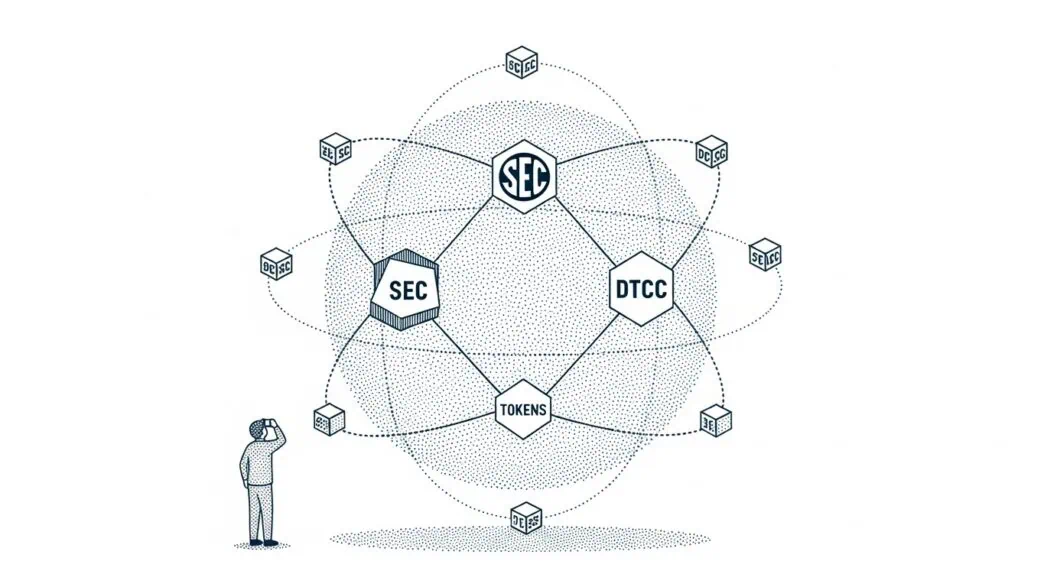
The U.S. Securities and Exchange Commission granted the Depository Trust & Clearing Corporation approval to tokenize stocks, bonds, and Treasuries on December 11, 2025. The SEC issued a no-action letter to DTCC’s subsidiary DTC, allowing the firm to custody and recognize tokenized equities and real-world assets on-chain.
This is not experimental. This is production-scale institutional tokenization.
The approval grants DTCC ability to offer tokenization services on pre-approved blockchains for three years. The move gives DTCC authority to create digital representations of DTC-custodied assets while maintaining all existing investor protections and legal rights.
DTCC processes $3.7 quadrillion in securities transactions annually. When the backbone of U.S. capital markets embraces blockchain technology, it validates institutional tokenization at unprecedented scale.
Frank La Salla, DTCC President and CEO, stated in the official announcement, “Tokenizing the U.S. securities market has the potential to yield transformational benefits such as collateral mobility, new trading modalities, 24/7 access and programmable assets, but this will only be achievable if market infrastructure provides a robust foundation to usher in this new digital era.”
What Assets Can Be Tokenized
The SEC approval covers a defined range of highly liquid instruments that represent core components of institutional portfolios.
First, Russell 1000 equities. The Russell 1000 Index comprises the thousand largest companies in the Russell 3000 Index, representing approximately 93% of U.S. equity market capitalization. Tokenizing these securities enables institutional investors to access blockchain-based settlement for major U.S. stocks.
Second, major index ETFs. Exchange-traded funds linked to major benchmarks like S&P 500, Nasdaq-100, and Russell 2000 fall within the approval scope. These instruments provide broad market exposure while benefiting from blockchain settlement efficiency.
Third, U.S. Treasury securities. Treasury bills, notes, and bonds represent the safest assets in global financial markets. The SEC outlined its position confirming DTCC would not face enforcement action for minting or retiring tokens representing security entitlements already under its custody.
The service will initially operate in a controlled production environment for DTC Participants and their clients. Digital versions of these assets carry the same investor protections, rights, and entitlements as traditional forms, with identical operational safeguards applied across DTC’s existing infrastructure.
DTCC Selects Canton Network as Blockchain Partner
Six days after SEC approval, DTCC announced its blockchain infrastructure partner. On December 17, 2025, DTCC partnered with Digital Asset and Canton Network to enable tokenization of DTC-custodied assets starting with U.S. Treasury securities.
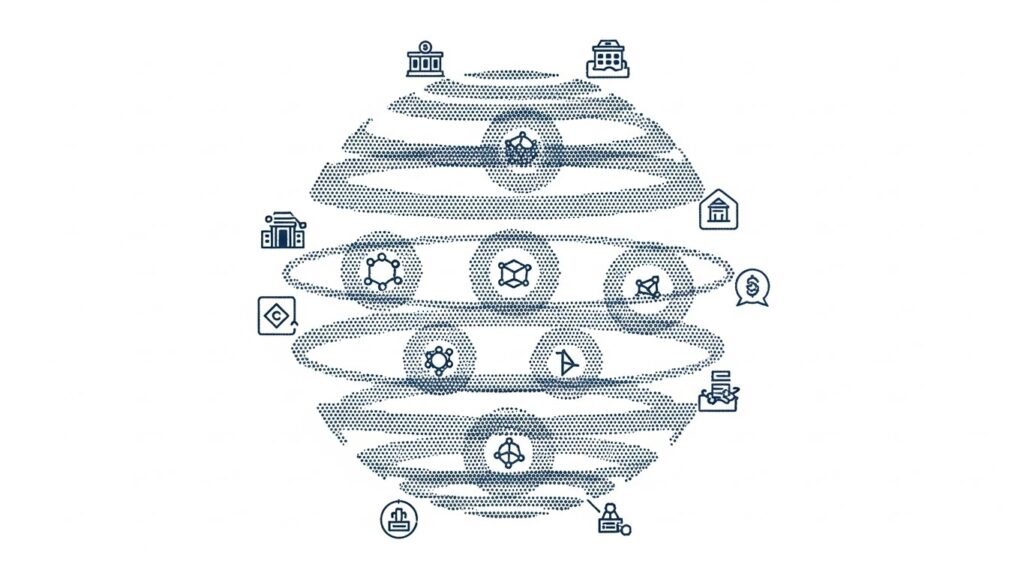
Canton Network is the first privacy-enabled open blockchain network designed specifically for institutional finance. Unlike public blockchains, Canton employs sub-transaction privacy ensuring sensitive trade details remain visible only to relevant participants and regulators.
This privacy architecture solves a critical institutional requirement. Traditional finance firms cannot expose proprietary positions to broader markets. Canton enables shared-ledger synchronization without sacrificing confidentiality.
The Canton Network partnership represents DTCC’s first step toward making DTC-custodied assets available on-chain. Digital Asset, the firm behind Canton, is backed by powerful Wall Street institutions including BlackRock, Blackstone, Nasdaq, S&P Global, Goldman Sachs, and Citadel Securities.
DTCC will join the Canton Foundation as co-chair alongside Euroclear. This governance position ensures the world’s largest clearinghouses directly participate in setting standards for decentralized financial infrastructure.
Frank La Salla explained the strategic rationale in DTCC’s official statement, “This collaboration creates a roadmap to bring real-world, high-value tokenization use cases to market, starting with U.S. Treasury securities and eventually expanding to a broad spectrum of DTC-eligible assets across network providers.”
How DTCC Tokenization Works
DTCC’s tokenization architecture preserves existing ownership structures while enabling blockchain-based settlement. Understanding the technical workflow clarifies how traditional finance integrates with distributed ledger technology.
When DTC participants elect to tokenize holdings, DTCC moves securities from its central ledger into a digital omnibus account. The firm then uses its Factory system to mint and deliver tokens representing participants’ security entitlements to registered wallets on approved blockchains.
Critically, registered ownership never changes. Securities remain registered in the name of Cede & Co., DTC’s nominee. Tokenization creates digital representations of existing entitlements rather than transferring legal ownership to blockchain addresses.
DTCC maintains a root wallet with authority to reverse or fix transactions if mistakes or misconduct occur. This mirrors existing U.S. market protections where clearing agencies can unwind trades under specific circumstances.
The Factory system operates as software maintained by DTC that mints tokens based on participants’ registered wallet addresses. LedgerScan, another key component, monitors blockchain state to ensure DTC’s records match on-chain token distributions.
DTCC will leverage its ComposerX suite of platforms to enable tokenization. ComposerX provides the technical infrastructure connecting DTC’s existing systems with blockchain networks, creating a unified pool of liquidity across traditional finance and decentralized finance ecosystems.
Why This Changes Institutional Finance
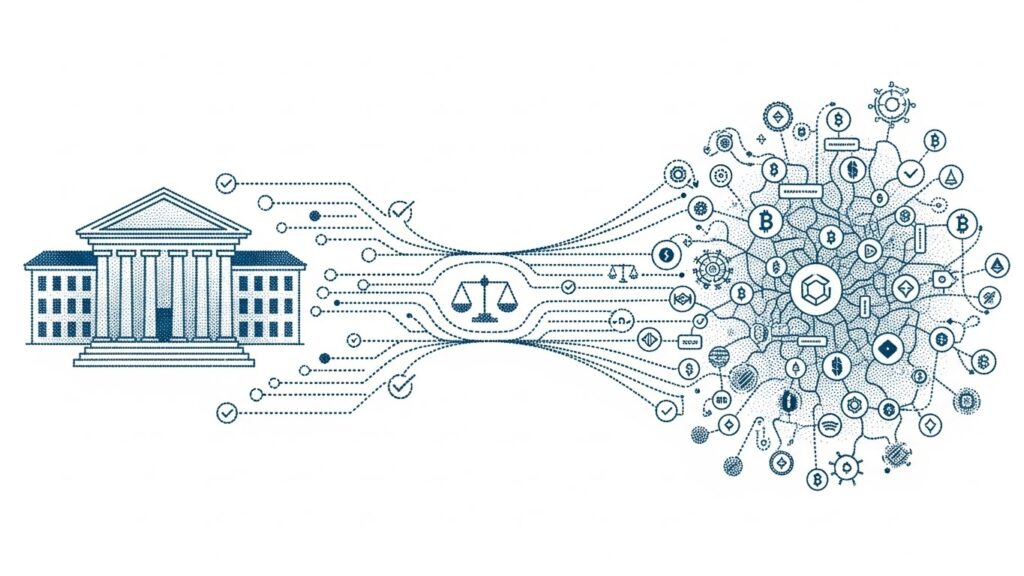
DTCC’s tokenization initiative fundamentally reshapes how institutional capital accesses blockchain technology. Several transformational benefits emerge from regulated, infrastructure-level tokenization.
First, 24/7 settlement. Traditional markets operate during business hours with T+1 settlement cycles. Tokenized securities settle in near real-time around the clock, unlocking capital that would otherwise sit idle overnight and weekends.
Second, collateral mobility. Institutional investors constantly move collateral to support trading activities, margin requirements, and risk management. Programmable assets enable instant collateral transfers between counterparties without intermediary delays.
Third, operational efficiency. Tokenization reduces reconciliation work, minimizes custody chains, and automates settlement processes. The financial services industry spends billions annually on post-trade reconciliation that blockchain eliminates.
Fourth, new trading modalities. Smart contracts enable conditional settlement, automated corporate actions, and programmable compliance. Institutions can encode complex trading logic directly into digital assets.
Fifth, regulatory transparency. Blockchain provides immutable audit trails visible to regulators in real-time. This transparency reduces compliance costs while improving market oversight.
The scale matters profoundly. DTCC processed securities transactions valued at $3.7 quadrillion in 2024 and provides custody for securities from over 150 countries valued at approximately $76 trillion. When infrastructure of this magnitude embraces tokenization, it catalyzes industry-wide adoption.
Brian Steele, Managing Director and President of Clearing & Securities Services at DTCC, emphasized this transformation in the announcement, “In partnership with our clients and the broader market, we will tokenize securities with uncompromising security, sound legal footing and seamless interoperability, all backed by the resilience that has anchored traditional markets for decades.”
2026 Rollout Timeline
DTCC anticipates beginning to roll out the tokenization service in the second half of 2026. The phased approach balances innovation with institutional risk management.
Phase one targets minimum viable product deployment in first half of 2026. DTCC and Canton Network are working toward MVP in a controlled production environment, with plans to increase size and scope based on client interest.
The initial rollout focuses on U.S. Treasury securities as the foundation asset class. Treasuries provide ideal starting point due to standardization, high liquidity, and broad institutional ownership. Success with Treasuries establishes proof-of-concept before expanding to equities and ETFs.
Phase two expands asset coverage throughout 2026 and beyond. Russell 1000 stocks and major index ETFs enter the program as DTCC validates technical infrastructure and operational processes. The multi-year roadmap eventually encompasses broad spectrum of DTC-eligible assets.
DTCC will provide details about on-boarding requirements including wallet registration and blockchain approval processes in coming months. DTC Participants wishing to use tokenization services must register one or more addresses on approved blockchains for holding tokenized entitlements.
The three-year authorization from SEC provides runway for comprehensive deployment. DTCC can iterate, expand, and optimize the service based on participant feedback and market conditions without seeking additional regulatory approval.
Market Implications for RWA Sector
DTCC’s entry into tokenization validates the real-world asset sector at unprecedented scale. The market implications extend far beyond immediate technical implementation.
First, institutional credibility. When the organization processing $3.7 quadrillion annually embraces blockchain, it eliminates lingering doubts about distributed ledger viability for traditional finance. Pension funds, sovereign wealth funds, and insurance companies gain confidence to explore tokenized assets.
Second, standardization pressure. DTCC’s infrastructure choices influence industry standards. The selection of Canton Network signals privacy-preserving architectures as institutional preference over fully public blockchains. Other market participants will align technical approaches accordingly.
Third, competitive acceleration. DTCC’s move forces other market infrastructure providers to advance tokenization initiatives. Euroclear, Clearstream, and regional clearing agencies must match capabilities or risk losing competitive position.
Fourth, regulatory template. The SEC no-action letter establishes framework other jurisdictions may follow. European, Asian, and other regulatory bodies observe U.S. approach as potential model for blockchain integration.
Fifth, capital formation opportunities. Tokenization unlocks new investment structures impossible in traditional infrastructure. Fractional ownership, programmable distribution, and instant settlement create product innovation possibilities.
The tokenized RWA market crossed $30 billion in 2025. DTCC’s participation accelerates growth trajectory toward projections of $16-30 trillion by 2030. Infrastructure-level adoption drives exponential scaling beyond current experimental deployments.
Regulatory Framework and Compliance
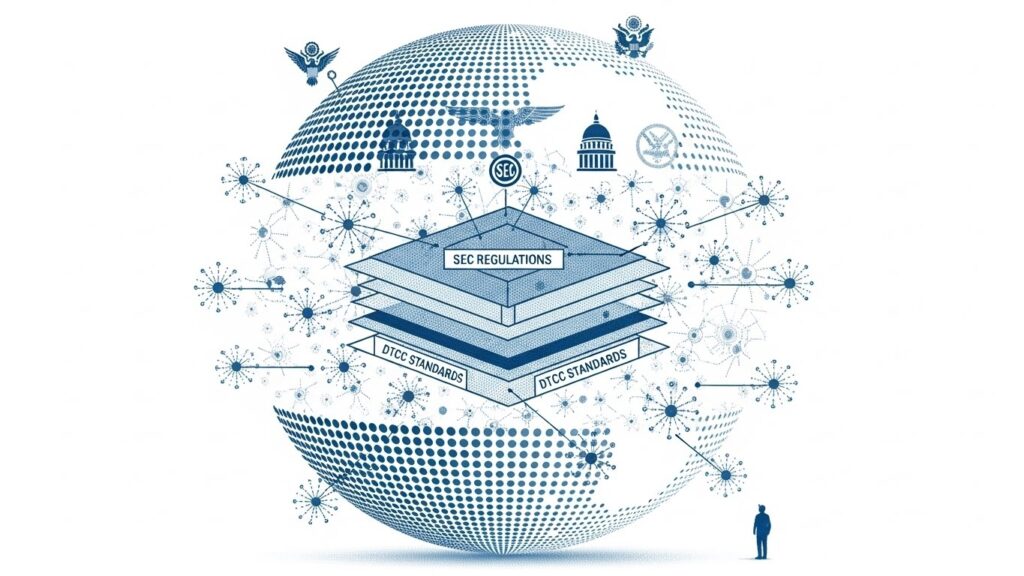
The SEC no-action letter establishes specific conditions and compliance requirements ensuring tokenization operates within existing regulatory frameworks.
DTCC must comply with Regulation SCI obligations governing systems capacity, integrity, resiliency, availability, and security. The systems performing key tokenization functions maintain Tier 2 or better ratings within DTCC’s internal structure, meaning ability to operate from primary and secondary locations with maximum resilience.
DTC management delivers Systems Event information to its Board of Directors at next regularly scheduled meeting following any incidents. This governance oversight ensures board-level awareness of operational issues.
The no-action relief temporarily eases several regulations ordinarily governing clearing agencies. This regulatory flexibility establishes controlled environment for DTCC to evaluate blockchain-based workflows while preserving existing ownership rights and avoiding creation of new securities classes.
DTCC submits quarterly reports throughout the three-year pilot. These updates outline number of participating firms, value of tokenized entitlements, which blockchains were used or declined, outage events, registered wallet totals, and instances where DTCC exercised reversal authority.
Transparency requirements help regulators track program progress and assess broader implications. The structured reporting creates accountability framework that could extend to other tokenization initiatives.
Importantly, tokenized entitlements carry identical investor protections as traditional securities. Legal rights, ownership claims, and recourse mechanisms remain unchanged. Blockchain technology provides new infrastructure layer without altering fundamental investor safeguards.
Any DTC Participant can elect to participate except those for which DTC has U.S. tax withholding, reporting obligations, or Treasury International Capital reporting requirements. This carve-out addresses operational complexity where blockchain settlement may conflict with existing reporting infrastructure.
Frequently Asked Questions
What did the SEC approve for DTCC?
The SEC issued a no-action letter on December 11, 2025, allowing DTCC’s subsidiary DTC to tokenize stocks, ETFs, and Treasury securities on approved blockchains. The authorization covers a three-year pilot period for Russell 1000 equities, major index ETFs, and U.S. Treasury bills, notes, and bonds.
What is Canton Network?
Canton Network is a privacy-enabled blockchain designed specifically for institutional finance. Developed by Digital Asset and backed by BlackRock, Goldman Sachs, Nasdaq, and other Wall Street firms, Canton enables shared-ledger synchronization while preserving sub-transaction privacy required by financial institutions.
When will DTCC tokenization go live?
DTCC anticipates rolling out tokenization services in second half of 2026. The initial phase focuses on U.S. Treasury securities in a controlled production environment, with expansion to stocks and ETFs following successful Treasury implementation.
How does DTCC tokenization differ from existing crypto?
DTCC tokenization creates digital representations of real securities held in custody, maintaining all existing investor protections and legal rights. Unlike crypto tokens, these represent actual ownership claims to regulated securities with SEC oversight and clearing agency safeguards.
What assets can be tokenized under SEC approval?
The approval covers Russell 1000 stocks (largest 1,000 U.S. companies), ETFs linked to major benchmarks like S&P 500 and Nasdaq-100, and U.S. Treasury securities including bills, notes, and bonds. DTCC may expand to broader DTC-eligible assets over the three-year pilot period.
Why does DTCC tokenization matter for institutional investors?
Tokenization enables 24/7 settlement, instant collateral mobility, reduced operational costs, programmable assets, and new trading modalities. For institutions managing billions in assets, these efficiency gains translate to significant capital optimization and risk management improvements.
Related Resources
Learn more about institutional blockchain and tokenization infrastructure:
- SBI Ripple Asia Doppler Finance Partnership: XRP Yield Infrastructure
- BlackRock Tokenized Assets BUIDL Fund: $2.9B Institutional Analysis
- Hyperliquid DEX Review 2025: Institutional DeFi Platform
Sources
- DTCC Authorized to Offer New Tokenization Service – DTCC Official
- SEC Gives DTCC OK to Tokenize Stocks in Move to Blockchain – Bloomberg
- DTCC Authorized to Offer New Tokenization Service – Business Wire
- DTCC and Digital Asset Partner to Tokenize U.S. Treasury Securities – Canton Network
- DTCC and Digital Asset Partner on Canton Network – DTCC Official
- Wall Street Giant DTCC Picks Canton Network for Tokenization – CoinDesk
- SEC Backs DTCC Three-Year Pilot to Tokenize U.S. Securities – The Crypto Basic
- SEC Green Lights Stock Tokenization via DTCC Subsidiary – Ledger Insights
- DTCC Receives SEC No-Action Relief to Launch Tokenisation Service – The TRADE
- DTCC Partners with Digital Asset Holdings and Canton Network – Asset Servicing Times
- The Financial Backbone Goes On-Chain: DTCC Selects Canton Network – FinanceFeeds