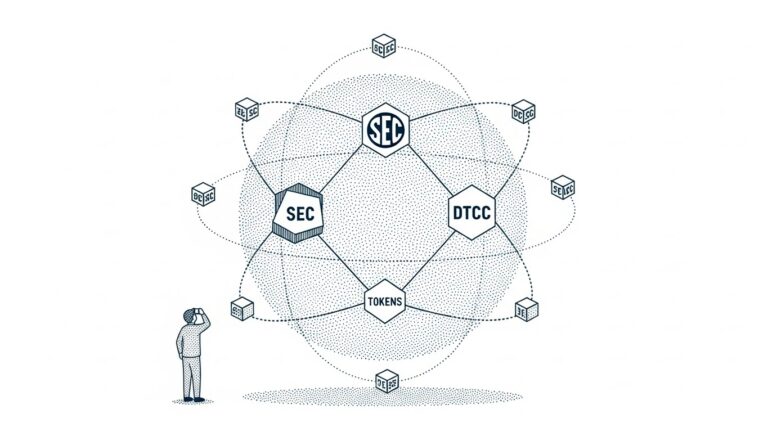
A token can move in seconds. The legal claim it represents may take months to enforce. That distinction is the starting point for this RWA tokenization market report for 2026.
Real-world asset markets are moving beyond experiments, but the industry still uses incompatible definitions of market size, ownership and settlement. A billion dollars recorded on a ledger is not necessarily a billion dollars available to an investor. This report separates the financial instrument from the technology used to distribute it, and actual deployment from future market scenarios.
Research snapshot: 27 November 2026. All monetary figures are in US dollars unless otherwise stated. This is a dated market report, not a live price feed or an investment recommendation.
RWA tokenization market report: scope and ownership rights
Real-world asset (RWA) tokenization uses a digital ledger to issue, record or transfer a claim associated with an asset outside the conventional cryptocurrency economy. The asset may be a government bond, a fund share, a loan, a commodity or an interest in a property-owning company. The token is a record or instrument; the enforceable rights come from the applicable legal structure.
Consider three tokens described as exposure to the same government bond. The first is issued by the bond issuer and forms part of the official ownership record. The second is issued by a fund that owns the bond, so its holder owns a fund share. The third is issued by a separate company promising payments linked to the bond’s performance. The economic exposure may look similar, but the legal claims, insolvency outcomes and redemption rights differ.
| Structure | What the holder may own | Key question |
|---|---|---|
| Issuer-native instrument | The security itself under its governing law | Is the ledger an authoritative ownership record? |
| Fund or special-purpose vehicle | A share or contractual interest in an entity holding assets | What is the claim against the entity and its assets? |
| Third-party linked instrument | A claim against an intermediary tied to asset performance | What happens if the intermediary fails? |
The SEC staff statement on tokenized securities illustrates why issuer-sponsored and third-party arrangements require separate analysis. A technology label does not replace securities law. Its relevance also depends on jurisdiction and the particular instrument.
How a tokenized asset is created
STEP 01
Legal structure
Define the asset, issuer, holder rights and governing law.
STEP 02
Custody and verification
Establish who holds underlying assets, who reconciles records and what independent evidence is available.
STEP 03
Issuance
Create the digital instrument and admit eligible investors under the applicable distribution rules.
STEP 04
Transfer and settlement
Move the asset and payment according to the venue’s rules, with compliance and finality controls.
STEP 05
Servicing and redemption
Process income, voting or corporate actions and redemption according to the instrument’s terms.
Not every arrangement needs a separate custodian or special-purpose vehicle. Some instruments are issued directly on a legally recognized ledger. What matters is whether the legal and operational records agree, and what process applies when they do not.
How large is the tokenized asset market?
The RWA.xyz tokenization platforms dashboard reported the following values in its indexed 27 November 2026 snapshot. These are provider-defined measures of tracked assets, not a census of every tokenization project worldwide. A separate view of networks may differ slightly because of refresh timing.
Distributed RWA
$41.28 billion
Assets categorized by the data provider as distributed.
Represented RWA
$451.86 billion
Assets categorized as represented; not necessarily accessible through freely transferable tokens.
RWA.xyz distinguishes platforms using the blockchain for investor-facing distribution from those using it to represent assets. This matters: a record of a large underlying portfolio may be useful for reconciliation or servicing without making the portfolio broadly investable on-chain. Neither category measures available bids, trading depth or the amount that could be sold immediately.
For market analysis, track distributed value, represented value, stablecoin supply and transaction volume separately. Even when two metrics are denominated in dollars, they may count different economic activities. Summing across sources can double-count the same underlying security, including assets represented by a fund or a second token.
| Metric | Reading | Interpretation |
|---|---|---|
| Distributed asset value | $41.28bn | RWA.xyz tracked distribution; not liquidity |
| Represented asset value | $451.86bn | RWA.xyz tracked representation; not freely tradable float |
| Kinexys cumulative transactions | Over $4tn, reported October 2026 | Flow since inception, not assets outstanding |
| Kinexys average daily transactions | $7bn, reported October 2026 | Daily flow, not market capitalization |
This register is a research framework, not a proprietary price-weighted index or a composite investment benchmark. It will require consistent observations before a historical series can be calculated. The Kinexys figures come from the bank’s October 2026 announcement, not RWA.xyz. For the separate year-specific growth narrative, see our RWA market growth analysis.
Why transaction volume is not market capitalization
Imagine a $100 million portfolio used for ten successive collateral transfers. The underlying portfolio remains worth $100 million, while aggregate transfers can reach $1 billion. If a fund share is then pledged as collateral, that does not necessarily create another $100 million of new underlying assets. Activity can increase dramatically without a corresponding increase in outstanding investment value.
The most useful additional indicators are net subscriptions, redemptions, actual trading volume, active eligible counterparties, bid-ask spreads and settlement failures. Without reliable comparable data, an impressive dollar total cannot establish which platform has the healthiest secondary market. This report does not manufacture missing asset-class breakdowns or historical growth rates.
BlackRock BUIDL: what institutional adoption looks like
BlackRock launched the USD Institutional Digital Liquidity Fund, known as BUIDL, in March 2024, with Securitize providing tokenization services. The original launch announcement describes a fund investing in cash, US Treasury bills and repurchase agreements. The token represents fund exposure, not an individual Treasury bill registered directly in each holder’s name.
Securitize announced that BUIDL had exceeded $1 billion in assets under management in March 2025. Later that month, it announced a Solana share class. These dated milestones demonstrate adoption and expansion beyond the original Ethereum deployment. They are not presented as today’s fund size.
In November 2026, Securitize and Ethena announced a $100 million liquidity facility for BUIDL. A facility is a contractual source of liquidity subject to its own terms and capacity; it does not mean every investor can redeem unlimited amounts at any moment. It also should not be added to fund assets under management as if it were new invested capital.
The development is significant because tokenized collateral needs usable funding mechanisms as well as digital transfer functionality. Our BUIDL fund guide and BlackRock tokenization strategy analysis provide dedicated coverage of the product and the manager’s broader direction.
Banks, fund managers and financial market infrastructure

Institutional adoption takes several forms: a registered fund using a blockchain-integrated transfer agent, a private fund distributed to eligible wallets, a bank payment rail, and a securities settlement venue. They solve different problems. Putting all of them into the same league table would conceal more than it reveals.
| Institution or initiative | Observed development | What it demonstrates |
|---|---|---|
| BlackRock / Securitize | BUIDL launch in 2024; Solana share class in 2025; liquidity facility announced 2026 | Fund distribution and collateral financing |
| Franklin Templeton | BENJI blockchain-integrated money fund; five-year milestone in 2026 | Registered fund recordkeeping and eligible transfers |
| JPMorgan Kinexys | JPM Coin deposit token on Ethereum, announced October 2026 | Bank-issued payment instrument and settlement infrastructure |
| BX Digital | Swiss DLT trading facility licensed in March 2025 | Regulated market infrastructure using public-chain settlement |
| MAS Project Guardian | Industry frameworks and tokenization use cases | Collaboration and standards development, not aggregate fund assets |
Franklin Templeton’s BENJI transfer announcement explains how a token represents a fund share and how its transfer agent maintains the official record. Its 2026 milestone announcement provides further context on peer-to-peer transfers and on-chain distributions. Neither announcement eliminates fund investment risk.
JPMorgan’s October 2026 announcement of JPM Coin on Ethereum is another development worth separating from securities issuance. A deposit token is a payment instrument connected to a bank liability under its terms, whereas a fund token is an investment interest. The bank reported more than $4 trillion in cumulative Kinexys transactions and average daily activity of $7 billion. Its cross-chain settlement test with Ondo and Chainlink also shows that experiments can connect asset and payment legs across distinct infrastructures. A test is not proof of unrestricted commercial availability.
Existing PCX coverage includes JPMorgan’s MONY fund and the DTCC and Canton infrastructure initiative. These older articles provide historical context and require their own updates; the current production status is sourced from DTCC above.
From pilots to production: four milestones
1 November 2024 — UBS launches uMINT
UBS announced its Ethereum-based money market investment fund.
4 November 2025 — UBS fund servicing
28 October 2026 — DTC production launch
DTCC confirms the voluntary tokenization service entered production.
16 November 2026 — Allfunds selects Centrifuge
Centrifuge announced selection for tokenized fund distribution, including JTRSY and JAAA.
These events address different bottlenecks: fund issuance, transfer-agent workflow, securities entitlements and distribution. Allfunds’ distribution network size is not capital already invested in tokenized funds. DTC’s production launch similarly does not mean every security in its custody has become a token. Its 12 November announcement describes planned Solana connectivity, rather than an already operational Solana integration.
The asset classes behind tokenization
| Asset class | Typical structure | Risk or constraint |
|---|---|---|
| Government debt | Direct instrument or fund share | Duration, fund expenses, redemption and eligibility |
| Private credit | Loan participation, fund or vehicle interest | Default, recovery, valuation and limited liquidity |
| Real estate | Shares in property-owning entity or other contractual claim | Local property law, leverage, manager and exit restrictions |
| Gold and commodities | Custodial claim or linked instrument | Verification, storage, delivery and counterparty terms |
| Equities | Issuer-native security or third-party representation | Voting rights, corporate actions, issuer/intermediary risk |
| Fund interests | Shares or units in a managed portfolio | Fund rules, subscription windows, gates and expenses |
Tokenized Treasuries and money market funds
These products are often described as on-chain cash equivalents because their portfolios may hold short-duration government securities. However, their returns vary with rates, expenses and portfolio composition. A fund can restrict withdrawals, and its shares do not acquire deposit insurance simply because they are held with a bank. A direct government security and a fund investing in government securities are different legal instruments.
For a treasury operation, the relevant question is whether the instrument can be used as collateral with an approved counterparty, and at what haircut. A haircut reduces the collateral value recognized by the lender: a $1 million position with a hypothetical 5% haircut supports at most $950,000 of recognized collateral value before other limits. That example illustrates a mechanism, not any particular provider’s terms.
Private credit
Tokenization can make subscription records, interest allocations and loan servicing more efficient, but it does not perform the borrower’s work or guarantee repayment. Investors remain exposed to underwriting quality, loan covenants, concentration, recovery costs and the legal ranking of their claim. A tokenized loan can default even if its smart contract executes perfectly.
For comparison, distinguish committed capital from drawn loans and outstanding principal. A lending platform may report cumulative originations, whereas another reports only active balances. A yield calculation based on advertised coupon rates may omit defaults and fees. Those differences matter more than a superficial comparison of protocol sizes.
Real estate and physical assets
A property token commonly represents an interest in an entity that holds property rather than a name on the local land registry. A fractional investor may have limited voting rights, no right to occupy the building and no ability to compel a sale. The property may be mortgaged. Rental income can be reduced by operating costs, vacancy, tax and financing expenses.
The same principle applies to aircraft. A token associated with a private jet could represent equity in a vehicle, a revenue claim, a loan or a contractual access right. It does not automatically grant title to the aircraft or the ability to charter it. Our private jet tokenization guide explores this application in more detail.
Gold, equities and structured exposure
For commodity products, identify the custodian, whether holdings are allocated or pooled, whether physical delivery is possible, and who pays storage and insurance. For equities, distinguish actual shareholder rights from a contract tracking the share price. Dividend treatment, voting, splits and corporate actions must be addressed in the legal terms. A familiar ticker does not prove an equivalent legal position.
Observable product-level data
Selected dated observations provide a more defensible comparison than combining incompatible aggregate estimates. The figures below are not market shares and must not be summed.
| Product or platform | Reported value | Definition and source |
|---|---|---|
| Figure HELOC Token | $27.43bn | Represented credit value, RWA.xyz indexed data, 27 Nov. |
| WisdomTree WTGXX | $675.40m | Distributed fund value, RWA.xyz indexed data, 27 Nov. |
| Centrifuge JAAA | $608.50m | 26 Nov NAV record in Centrifuge management app |
| Ondo Stocks | $1.3bn | Platform-reported TVL on 27 Oct., issuer announcement |
Figure’s represented home-equity credit illustrates how a large ledger-recorded loan portfolio can differ from a wallet-distributed fund. JAAA is a fund with exposure to AAA-rated collateralized loan obligations, not a guaranteed cash deposit. Ondo’s October TVL is a provider-reported platform metric, not secondary-market turnover. These examples demonstrate the diversity of tokenization structures, not their relative attractiveness.
Ondo’s 25 November distribution announcement describes more than 460 available tokenized assets. Product availability remains subject to the applicable offering terms and jurisdiction. A wallet integration does not automatically confer direct shareholder voting rights or unrestricted access to every investor.
Public and private blockchain infrastructure
Ethereum, Solana and private or permissioned financial networks can all support tokenized instruments. The decision is not simply which chain is fastest or cheapest. Issuers must account for privacy, permission controls, custody support, interoperability, operational resilience and legal settlement finality. A public ledger can host a token that only approved investors may transfer.
| Model | Potential advantage | Trade-off |
|---|---|---|
| Public blockchain | Shared verification, existing developer tooling and integrations | Public transaction visibility, network fees and external dependencies |
| Permissioned network | Controlled participation and data visibility | Restricted access and interoperability requirements |
| Multi-network issuance | Reach different eligible users and venues | Reconciliation, inconsistent permissions and cross-chain operational risk |
Cross-chain connectivity may use messaging protocols, synchronized transfers or independently issued share classes. It is not safe by definition. Verify how supply is reconciled and what happens when one network stops operating. The BIS Annual Economic Report 2026 chapter on monetary architecture explains why programmable assets need trustworthy settlement instruments and safeguards.
Settlement and the cash leg
Delivery versus payment (DvP) coordinates transfer of a security with its payment so that one leg does not settle without the other under the system’s rules. Atomic execution can reduce principal risk but may require cash and securities to be available at the same time. That can increase prefunding needs compared with a system that nets transactions before settlement.
A blockchain confirmation is not necessarily identical to legal finality or a completed bank withdrawal. Read the venue’s settlement rulebook, operational hours, failure procedures and accepted cash instruments. Stablecoins, bank deposit tokens and central-bank money are not interchangeable claims. See our institutional stablecoin guide for related context.
Regulation across major financial jurisdictions
Financial law follows the rights and activities involved, not simply the token’s name. A security can remain a security after tokenization. The legal analysis includes issuance, distribution, trading, custody, payments, investor classification and tax.
| Jurisdiction | Development | Scope limitation |
|---|---|---|
| United States | SEC staff statement, January 2026; conditional innovation exemption, September 2026 | Specific securities structures and qualifying venues; no blanket approval |
| European Union | ESMA DLT Pilot Regime | Conditional infrastructure exemptions for eligible financial instruments |
| Switzerland | FINMA first DLT trading facility licence, March 2025 | Licence concerns BX Digital; does not cover unrelated issuers |
| Singapore | MAS Project Guardian | Collaborative frameworks and industry initiatives; not product-level approval |
The US exemption concerns limited trading of certain tokenized NMS stocks (securities within the National Market System) through qualifying venues and conditions. It is temporary and conditional. In the EU, distinguish DLT financial instruments from crypto-assets falling under the Markets in Crypto-Assets Regulation (MiCA); the applicable classification must be assessed rather than assumed. Switzerland’s BX Digital example shows how public-chain settlement can operate inside regulated financial infrastructure.
Singapore’s Guardian initiative emphasizes practical adoption across issuers, asset managers, banks and custodians. Hong Kong’s HKMA announcement of 2 November 2026 describes an expanded Project Ensemble pilot enabling around-the-clock settlement in tokenized central-bank money. This is a settlement initiative, not a universal authorization for retail tokenized securities. The UAE remains outside the verified jurisdictional scope of this edition; individual regulatory regimes and product eligibility require separate research.
Due diligence: how to evaluate a tokenized asset
The following framework is educational. It is not a recommendation to buy a product, and it does not substitute for regulated advice. A token’s market value, advertised yield and technical security cannot establish the quality of the claim in isolation.
| Question | Evidence to examine |
|---|---|
| Who issues the token? | Legal entity, offering documents, governing jurisdiction |
| What is the underlying asset? | Portfolio holdings, custody agreements, independent reports |
| What do holders own? | Share register, contractual rights, voting, insolvency priority |
| Who can hold and transfer it? | Eligibility, transfer restrictions and sanctions controls |
| How is it valued? | Valuation policy, frequency, independent administrator |
| Can it be redeemed? | Redemption windows, fees, gates, liquidity facilities |
| What can go wrong technically? | Contract audits, upgrade permissions, key management, incident procedures |
| What happens when the issuer fails? | Asset segregation, insolvency analysis, trustee or recovery arrangements |
Do not treat a public contract address as evidence that the issuer is legitimate. Compare the address with official documentation and independently verify the domain, network and issuer. A token can have a similar name, logo or ticker to an established financial instrument. Our wallet fraud warning guide covers complementary operational risks.
Regulated custody, investor eligibility and disclosure requirements are important controls, but no one control provides a guarantee against loss. The BIS summary of tokenization’s financial stability implications offers a broader framework for understanding interconnected exposures and operational vulnerabilities.
Tax consequences depend on the instrument and the holder’s jurisdiction. A transfer, redemption or exchange can have different tax treatment. Maintain transaction records, acquisition costs and income statements, and obtain individual advice rather than assuming that an on-chain transaction is tax-exempt.
Market forecasts: why trillions are not interchangeable
Forecasts are not observations. The gap between published scenarios reflects differences in asset coverage, adoption assumptions, market definitions and time horizons. It does not establish a consensus range.
| Research | 2030 scenario | Scope and caveat |
|---|---|---|
| McKinsey, June 2024 | Around $2 trillion | Base case; excludes cryptocurrencies and stablecoins |
| BCG, 2026 | $14 trillion | Middle scenario for tokenized real-world assets; different assumptions |
2030 published scenarios (USD trillions)
McKinsey 2024 — $2tn
BCG 2026 — $14tn
Different methodologies. Bars show published scenario magnitudes, not comparable probabilities or observed market size.
BCG’s 2026 analysis also envisages $55 trillion by 2035 in its middle scenario. A later horizon cannot be compared with a 2030 estimate as though both referred to the same year. The historical $16 trillion-scale projection from BCG’s 2022 work is not a measured market value. The older headline of a $30 trillion market should therefore not be read as a current valuation or an established consensus.
The plausible adoption drivers are more specific than the forecasts themselves: improved fund distribution, collateral mobility, settlement coordination and automation of asset servicing. The constraints are equally important: legal harmonization, integration cost, fragmented liquidity, operational resilience and reliable digital cash. Institutions may adopt tokenization without moving all their assets onto public networks.
Frequently asked questions
Is tokenization the same as fractional ownership?
No. A whole instrument can be tokenized. Fractional participation can also exist without a blockchain. The product terms determine denomination and rights.
Is RWA market size the same as stablecoin supply?
No. Stablecoins are payment or value-stability instruments with their own structures. A market report should identify whether they are included before comparing totals.
Does tokenization guarantee instant liquidity?
No. Transfer technology can operate continuously while eligible buyers, redemption windows, cash availability and market makers remain limited.
What does an investor own in BUIDL?
An eligible interest in a fund under its offering terms, not an individually allocated Treasury bill. Consult current fund documentation for precise rights.
Will tokenization replace traditional finance?
There is no established timetable. Many initiatives integrate existing regulated institutions with new recordkeeping and settlement systems rather than replacing them.
Where can I track the market?
Start with RWA.xyz for provider-defined market data and issuer reports for product facts. For regulatory changes, consult the relevant financial supervisor. Check dates and definitions before comparing series.
Research methodology and update policy
This report distinguishes dated provider observations, issuer announcements, regulatory milestones, illustrative calculations and forecasts. Figures from different sources are not aggregated into an invented market index. The November snapshot uses indexed RWA.xyz platform data; an independently downloaded dataset and a consistent historical series are not yet available for this edition. The article’s original publication URL is intended to remain stable during future editorial updates. Individual products and legal rules can change after the research date.
Research by PCX editorial, 27 November 2026. No paid recommendations or individualized investment advice.